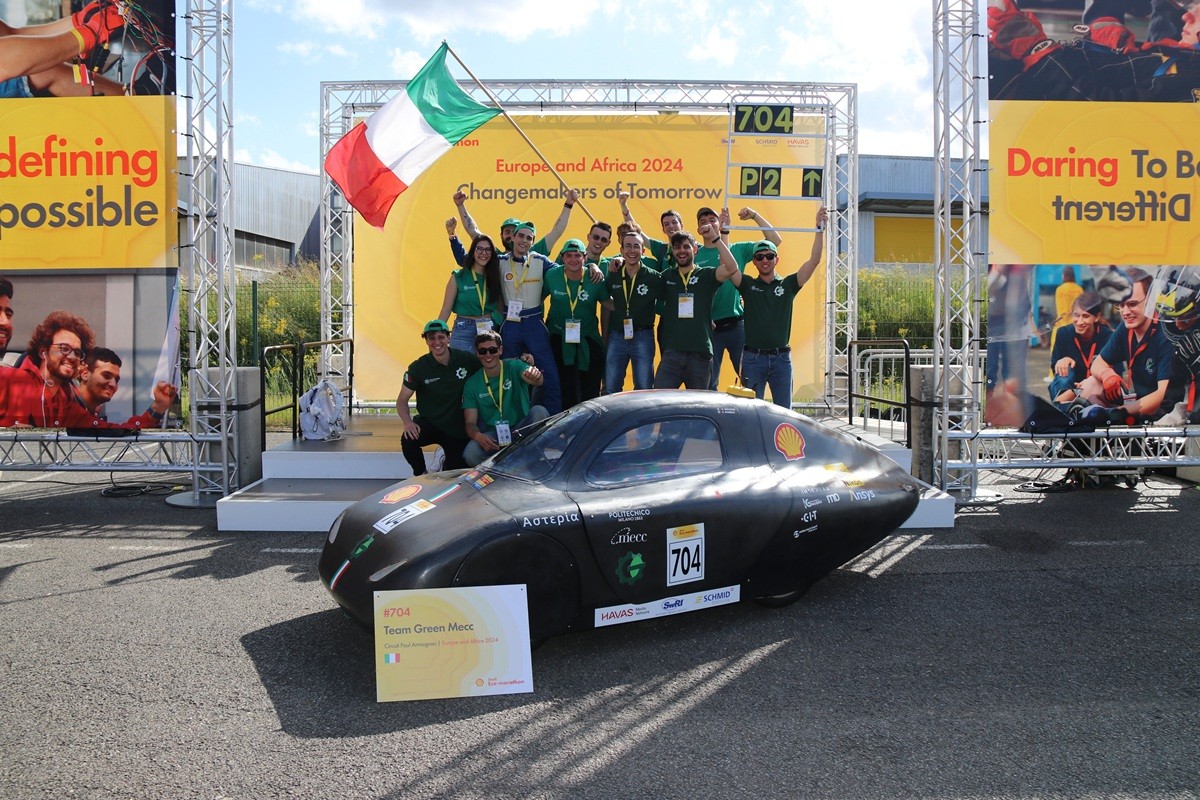

Shell Eco-Marathon is a motorsport competition for high school and university students from around the world to design and build energy-efficient vehicles. Teams can choose between two vehicle classes: Urban Concept, i.e., vehicles with road car-like features, and Prototype, i.e., lightweight and ultra-efficient and usually three-wheeled vehicles; there are three energy categories to choose from: internal combustion engine, electric battery and hydrogen fuel cell. The team is rewarded that achieves the lowest energy consumption on the track. The competition aims to stimulate discussion and collaboration between students in the development of ever cleaner energy solutions.
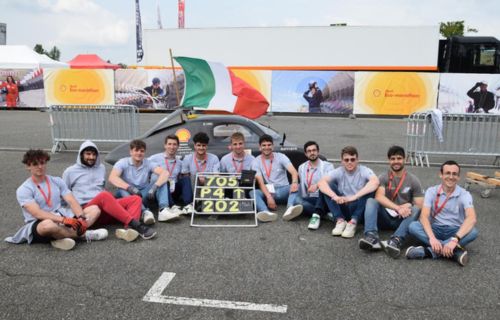
The Polimi Team
The Green Mecc has been taking part in the competition since 2005 and has been competing in the 'Urban Concept' class with a battery-electric vehicle since 2011. Today, the group is organised into six sectors: Management, Chassis & Subsystems, Drivetrain, Strategy & Electronics, Aerodynamics and Communication. The students take to the track with their prototypes bearing names from Greek mythology: after Apollo, Daphne and Leto, it is now time for Asteria.
Recruiting
Each year the team holds two recruiting sessions: the first in September and the second in March. The stages are open to all students at the Politecnico di Milano. For all candidates, the selection process consists of an oral interview designed to test general knowledge and motivation. To apply, please send an email (attaching your CV) to: sem-dmec@polimi.it.
Meet Team Green Mecc!
WHO IS PART OF THE TEAM?
We are Team Green Mecc and we compete in the Shell Eco-marathon, an international student competition focused on building a vehicle that is as efficient as possible in terms of fuel consumption and environmental impact.
We currently compete in the “Urban Concept” category and will soon also participate in the “Prototype” category.
The team was founded in 2008 and initially consisted only of interns and PhD students. Over the years, it expanded significantly and today includes around 100 students from the Politecnico di Milano, mainly enrolled in Mechanical and Aerospace Engineering programs. In addition to these courses, we also have students from Electronics, Automation, and Design.
The team is divided into several departments, including chassis, design, aerodynamics, logistics, electronics, and strategy. Each department has a team leader, and students choose their department based on their interests and academic background.
WHEN WAS THE TEAM FOUNDED AND HOW HAS IT EVOLVED OVER TIME?
The moment that most strongly marked the team’s evolution was when we grew from a small group of around ten interns or former interns to nearly fifty members.
From that point onward, the team experienced remarkable growth: new departments were created, tasks were divided, and every department had the opportunity to refine and specialize in its own field.
In addition, participating in competitions and events has always been an incredible experience. These are moments spent together in friendship and fun while learning an enormous amount and meeting students and universities from different countries.
WHAT IS THE TEAM’S MAIN ACTIVITY AND HOW DOES THE WORK DEVELOP DURING THE YEAR?
A typical day for the Design department involves designing components for the prototype, optimizing them, or working in the workshop assembling the parts that were previously modeled and engineered.
For the Electronics department, the work covers many different aspects. Since electronics manages several parts of the vehicle - from the steering wheel to telemetry systems and the motor - the department is divided into smaller subgroups dedicated to specific subprojects. Throughout the week, Friday is usually the day when most members are available, so we often work together in the workshop or update each other on progress.
The Strategy department mainly works virtually, either from home or from the office. We often collaborate through video calls. Our main responsibility is ensuring that the vehicle model is realistic and that solutions are found as early as possible before the competition.
As for the Aerodynamics department, our work takes place mostly through software rather than in the workshop. We usually work either in the office or remotely. At the moment, the department includes around twenty members divided among different tasks. Since the car’s purpose is to consume as little energy as possible, our job is to calculate the lowest possible drag coefficient and optimize the aerodynamic shape of the vehicle according to its expected speed and performance.
WHAT IS THE SECRET THAT KEEPS THE TEAM UNITED?
Within the Electronics department in particular, we have students from many different engineering backgrounds, including international students enrolled at the Politecnico. This creates not only academic diversity, but also cultural diversity.
Our primary goal has always been to involve everyone, and one of the best ways we achieved this was by organizing work into smaller subgroups. This allowed each member to adapt to their own skills and interests while avoiding rigid divisions based on age, nationality, or degree program.
Instead, we encourage constant interaction between different academic perspectives. This has created cohesive and collaborative working groups where everyone expands their knowledge. Overall, the environment within the team is extremely constructive.
WHAT IS THE FARTHEST CITY WHERE YOU HAVE COMPETED?
The farthest location we reached for the Shell Eco-marathon was the Silesia Ring circuit in Poland, about two hours from Kraków.
This experience refers specifically to the 2025 competition, when we traveled there by car. It turned into a real adventure - a long road trip starting from Milan and lasting about a day and a half.
ARE THERE ANY FUNNY MEMORIES OR UNEXPECTED EVENTS YOU REMEMBER?
One of the funniest moments happened during the technical inspections at the Shell Eco-marathon, which are always extremely stressful. Before being allowed onto the track, the car has to pass a series of technical checks carried out by race officials, including inspections of the windshield wiper system.
By mistake, our head of electronics had incorrectly set the speed of the windshield wiper. When he activated it, he did not realize it was set to maximum speed — the wiper literally flew off for about twenty meters, and everyone burst out laughing.
Fortunately, we managed to fix it quickly and still passed the technical inspections. It was one of those moments that broke the tension and helped everyone relax despite the stress.
Our greatest achievement, both personally and as a team, came in 2024 when we finished third overall in the Shell Eco-marathon. It was the first time in the team’s history that we reached the podium in the Urban Concept category. This also allowed us to advance to the next stage, an additional competition with slightly different rules that brought together the winners of each category.
This experience gave us enormous satisfaction because it was a goal we had hoped to achieve for many years, and reaching it made all of us incredibly proud.
WHAT ARE THE NEXT GOALS?
At the moment, we compete in the Urban Concept category, but we hope to reintroduce our team into the Prototype category as well.
The two categories are quite different: Urban Concept vehicles are designed to resemble everyday cars, meaning they need luggage space, a driver’s seat, and a reasonably comfortable environment. Prototype vehicles, on the other hand, are designed purely to achieve the highest efficiency possible.
3 REASONS WHY STUDENTS SHOULD JOIN THE TEAM
For the Design and Workshop departments especially, joining the team offers the opportunity to literally “get your hands dirty” and put into practice everything studied at the Politecnico. Students can spend years learning highly advanced theory, but without practical experience that knowledge risks remaining abstract. Working within the team gives students the opportunity to apply what they learn in real engineering projects.
Beyond practical skills, the team also helps students develop critical thinking and independent decision-making abilities, particularly when it comes to design choices and managing a project through all its stages.
Finally, joining the team means meeting many people who share the same passions and interests — people who have a lot to teach and a lot to learn from one another, creating a valuable experience for every member of the team.