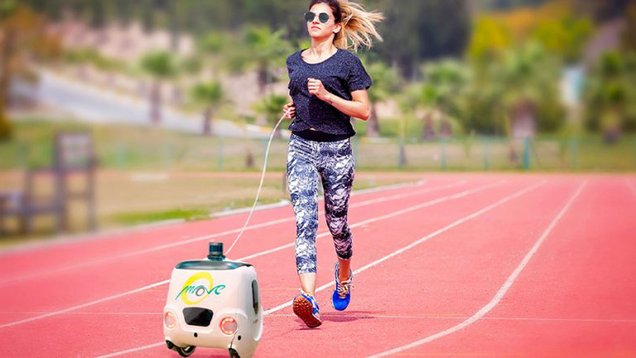

A team of researchers from different Politecnico departments (DEIB, DIG, DESIGN and DABC) has developed a robot capable of “guiding” blind and visually impaired people while walking, just like a guide dog or running pacer, helping them gain greater autonomy in everyday activities such as jogging in the park or going to a shopping centre. This led to the creation of BUDD-e (Blind-assistive aUtonomous Droid Device), a small robot capable of using sensors to “sense” the direction of the user and process information about the surrounding environment.
“The initial idea was to provide blind and visually impaired people with a tool that would make them autonomous while running, but the project later expanded into other areas when, together with our partners, we realised that there are various accessibility barriers in public spaces,” explains Prof. Marcello Farina (Department of Electronics, Information and Bioengineering), scientific director of the project. The researchers then submitted a series of questionnaires to several blind and visually impaired users to understand their habits and needs: it emerged that most of them (75%) only moved around when accompanied by friends, family members or volunteers, and that 1% did not leave their homes at all for fear of getting hurt. Budd-e can replace a companion: “The idea is to make it a public service, support that people can use when going to the supermarket, the park or the station,” explains Farina.
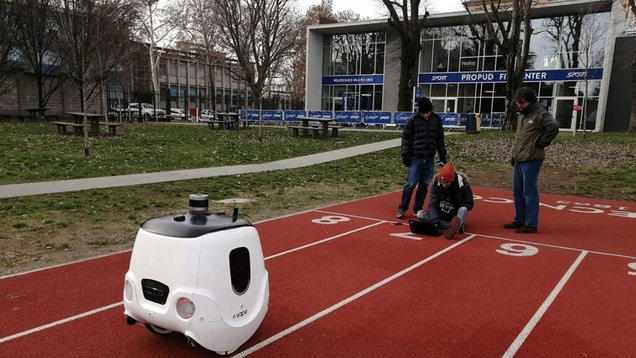
The first trials were carried out at Niguarda Hospital and at the Politecnico Giurati Sports Centre in 2021: Budd-e is the same size and has the same mobility as a wheelchair and is a 2.0 version of Yape, a robot already on the market used for last-mile delivery (also featured in MAP #7).
Compared with Yape, the most visible modification in Budd-e is the addition of a “tether” used to guide the user: “The tether is active and applies a force of 0.6 kilogram-force to the user, so they know where to go: Budd-e doesn’t pull the arm and only moves when the user moves, adapting to their speed and always maintaining the same distance,” explains Farina. Powered by electric batteries, Budd-e must first map the area in which it will move: in indoor environments (such as hospitals or shopping centres) LIDAR (Light Detection and Ranging) technology is required, while GPS mapping is sufficient for parks and open spaces.
This Politecnico “guide dog” is a work in progress, launched in 2021 thanks to a research grant funded through 5 per thousand donations.