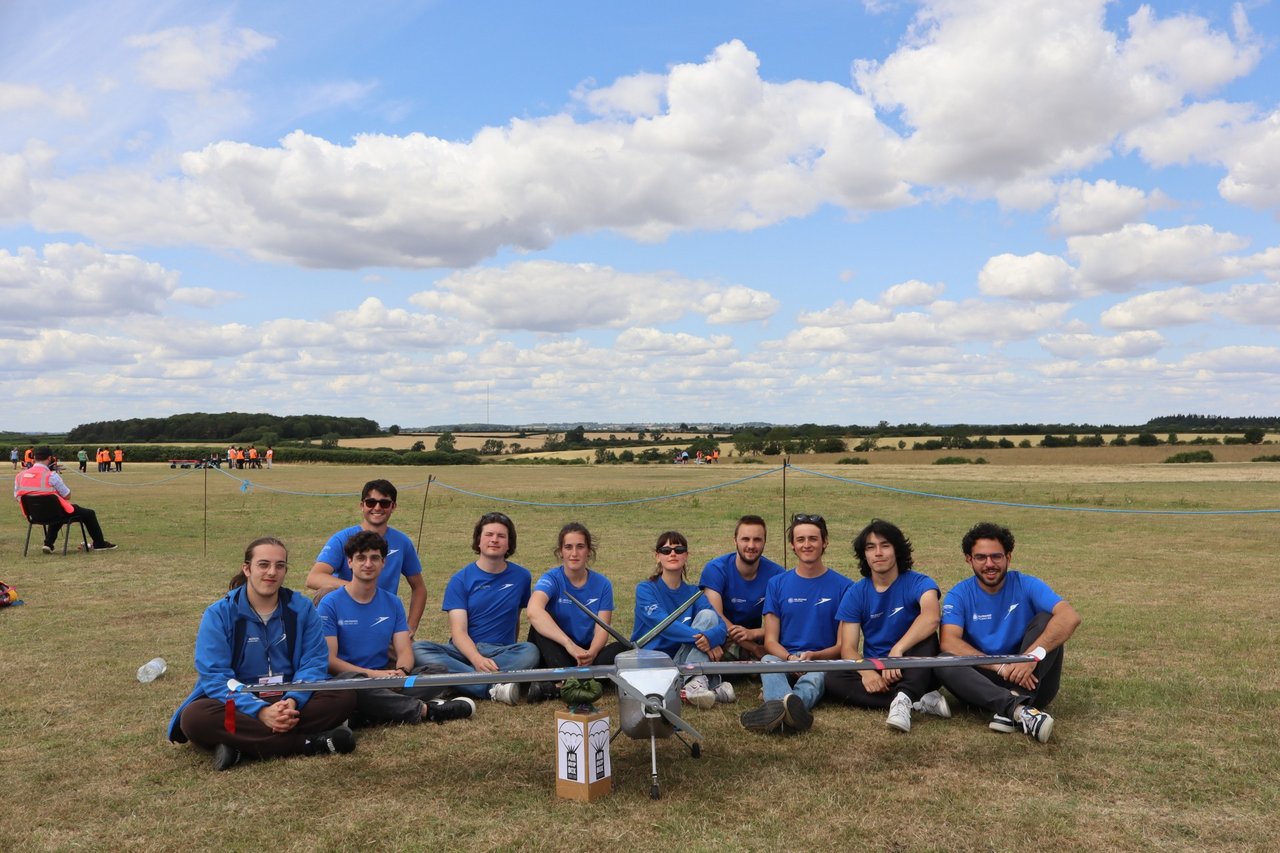

Air Cargo Challenge is an international competition in the field of auronautics for engineering students. The competing teams design and build a radio-controlled aircraft capable of carrying a payload. The score is awarded not only for flight performance, but also for the technical quality of the project.
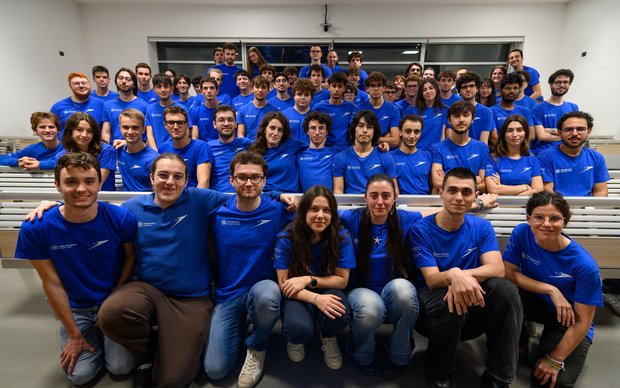
The Polimi Team
Fly Mi was born in 2022 and participates in the Air Cargo Challenge for the first time in 2024. The team now has about 100 members from 10 different courses of study: there are students of Aerospace and Aeronautical Engineering, but also of Management, Automation, Mechanical, Physics and Electronics Engineering. The team is structured in different departments: aerodynamics, flight mechanics, structures, electronics & propulsion, marketing and communication & media.
Meet Fly Mi!
WHO IS PART OF THE TEAM?
Fly Mi is made up of around 70 students divided into several departments that reflect the workflow involved in designing and building an aircraft — specifically, a fixed-wing drone.
Most members are students from the Politecnico di Milano enrolled in Aerospace or Aeronautical Engineering programs, as this naturally aligns with the association’s mission. However, the team also includes students from other fields, such as Automation Engineering, which is particularly valuable for the Electronics department, often responsible for designing autonomous control systems for our aircraft. We also have members from Management Engineering, Space Engineering, and Physics.
WHEN WAS THE TEAM CREATED, AND HOW HAS IT EVOLVED OVER TIME?
Fly Mi was founded as a student association at the end of 2022 by a group of Aerospace Engineering students who wanted to give other students the opportunity to experience the practical side of aircraft design. Fly Mi began working on its first drone project, called “ETRA,” which proved that the group was actually capable of designing and building a real aircraft.
From that moment onward, the association has continued to grow step by step. We started with ETRA during the 2023/2024 academic year and took part in our first international student competition, the “Air Cargo Challenge.” During the 2024/2025 academic year, we participated in another international competition, the “UAS Challenge,” introducing autonomous control systems into the prototype for the first time. This year, we aim to implement even more advanced solutions that we have never used before, such as retractable landing gear and a twin-engine configuration.
As for the human side of the association, it has naturally evolved over time in terms of size and expertise. Every year, we work hard to preserve and expand the knowledge and skills acquired in previous years. Over time, we have seen significant growth in both technical knowledge and practical expertise, not only in aircraft design but also in manufacturing, which we handle entirely in-house. We do not just design the drone: we build it ourselves.
WHAT IS THE TEAM’S MAIN ACTIVITY AND HOW DOES THE WORK DEVELOP DURING THE YEAR?
Fly Mi mainly develops electrically powered fixed-wing drones, as required by the competitions we participate in.
Regarding workflow, the first phase — lasting almost the entire first semester — is the design phase. The technical departments, including Aerodynamics, Structures, Flight Mechanics, and EPC (Electronics, Propulsion, and Control), work on different aspects of the project.
- The Aerodynamics department performs calculations to optimize the wing design
- Structures studies the aircraft’s technical characteristics to ensure it can withstand flight loads
- Flight Mechanics analyzes the drone’s stability to ensure it can complete the mission assigned by the competition organizers and that the aircraft configuration complies with the regulations
- Electronics develops the aircraft’s electrical system, naturally according to competition rules and technical limitations
These departments organize weekly meetings, alongside the independent work each student carries out depending on their role within the association. Around once a month, we hold a plenary meeting involving all departments to review the project’s progress.
WHAT IS THE SECRET THAT KEEPS THE TEAM UNITED?
The secret to keeping such a large and diverse group of students united — students coming from different academic backgrounds and departments within the university — is our shared passion for this type of project.
This commitment requires a huge amount of time and care. Fly Mi students are driven by a passion strong enough to keep everyone united throughout this challenge. Ours is not just a working group - it is also a group of friends.
WHAT IS THE FARTHEST CITY WHERE YOU HAVE COMPETED?
The farthest location we have competed in was Buckminster, in the United Kingdom, about three hours from London, where we participated in the UAS Challenge in 2025.
ARE THERE ANY FUNNY MEMORIES OR UNEXPECTED EVENTS YOU REMEMBER?
A memorable unexpected event happened last year during one of the first test flights of Olivia, one of our prototypes.
The drone had reached an excessively high internal temperature because it lacked proper air intake for cooling. At a certain point, the controls simply stopped responding… and the aircraft, flying at one hundred meters of altitude, decided to stop following our commands.
Fortunately, what saved the situation was the extensive Flight Mechanics study behind the design. Even without active controls, the aircraft maintained its trajectory and continued gliding along its ballistic path until it eventually crashed into a nearby field. Thankfully, nobody was hurt and the drone itself was not seriously damaged.
Our greatest satisfaction is undoubtedly seeing something we designed ourselves literally take flight. From an aeronautical engineering perspective, this kind of project involves an immense level of complexity.
WHAT ARE THE NEXT GOALS?
Our next goal is to reach Stuttgart in 2026 to participate in the “Air Cargo Challenge” and achieve a much better ranking compared to our previous participation, when we finished near the bottom of the overall standings. For us, this is a chance for redemption.
The new prototype will be called Heméra (“Day” in Ancient Greek).
WHY SHOULD SOMEONE JOIN THE TEAM?
The first reason is definitely the opportunity to apply in practice what is studied in lectures. In class, students learn theory, but if concepts never leave the blackboard, they remain too abstract. Fly Mi was created precisely with the goal of putting theory into practice while studying it. In turn, what students learn practically often becomes useful in later academic years as well.
The second reason is the opportunity to connect with the wider student community — meeting people from your own course or from similar programs, whether younger or older students, and experiencing university life at 360 degrees.
The final reason is the opportunity to engage with the industrial world. We regularly collaborate with companies and industry partners for every aspect of the aircraft’s design and construction, from materials and software to services and sponsorships.