

The quality of the urban environment influences the onset and progression of early-onset dementia
The DOUBTS project has shown that green urban areas,artificial light at night and traffic-related air pollution play a part in the risk of early-onset dementia and the evolution of symptoms in patients already diagnosed with it.
The project is coordinated by Andrea Rebecchi of the Politecnico di Milano and involves an interdisciplinary team consisting of Stefano Capolongo and Silvia Mangili (the Politecnico di Milano – DABC), Tommaso Filippini and Marco Vinceti (the University of Modena and Reggio Emilia), and Anna Odone and Paola Bertuccio (the University of Pavia). The study has drawn upon high-resolution environmental data – particularly in the province of Modena – including satellite datasets and advanced statistical models.
Andrea Rebecchi of the Department of Architecture, Built Environment and Construction Engineering at the Politecnico di Milano, said: “Overall, the results of the DOUBTS project indicate that an integrated approach is required to create dementia-friendly environments. Green urban areas need to be designed to avoid social isolation, and air and light pollution must be reduced through urban planning policies.”
AIR POLLUTION
Exposure to benzene, used as an indicator of pollution from vehicular traffic, is associated with an increased risk of early-onset dementia, and Alzheimer’s in particular, with an almost linear increase in risk beyond the threshold of 1.2 μg/m³.
Tommaso Filippini and Marco Vinceti, professors at the University of Modena and Reggio Emilia, explained: “The presence of a threshold effect of traffic pollution levels due to the increased risk of this disease is very important from the point of view of public health for setting exposure limits, especially for vulnerable groups. It is worth pointing out, too, that the average exposure levels of the population are in fact much lower than this threshold, indicating the effectiveness of the measures to reduce emissions taken in the past and in place to this day.”
GREEN URBAN AREAS
Green urban areas can help to protect against cognitive impairment and, in particular, early-onset dementia, notably Alzheimer’s. The presence of quality green urban areas is associated with a significant reduction in risk due to the promotion of physical activity and the reduction of stress and oxidative processes.
A counterintuitive result shows that extensive green urban areas are associated with an increased risk of apathy in patients already diagnosed with dementia, social isolation typical of less urban areas.
ARTIFICIAL LIGHT AT NIGHT (ALAN)
There are two sides to ALAN. On one side, high levels of artificial light at night are associated with a lower risk of early-onset dementia, probably because people most exposed to light at night are also those with more active social lives, and therefore with greater cognitive stimulation. On the flipside, high exposure makes subjects with mild cognitive impairment over three times more likely to go on to develop dementia.
In patients already diagnosed with dementia, artificial light at night is one of the main aggravating factors of neuropsychiatric symptoms. Above-average exposure doubles the risk of delusions, hallucinations and sleep disorders, with a particularly marked impact on Circadian rhythm sleep-wake disorders.
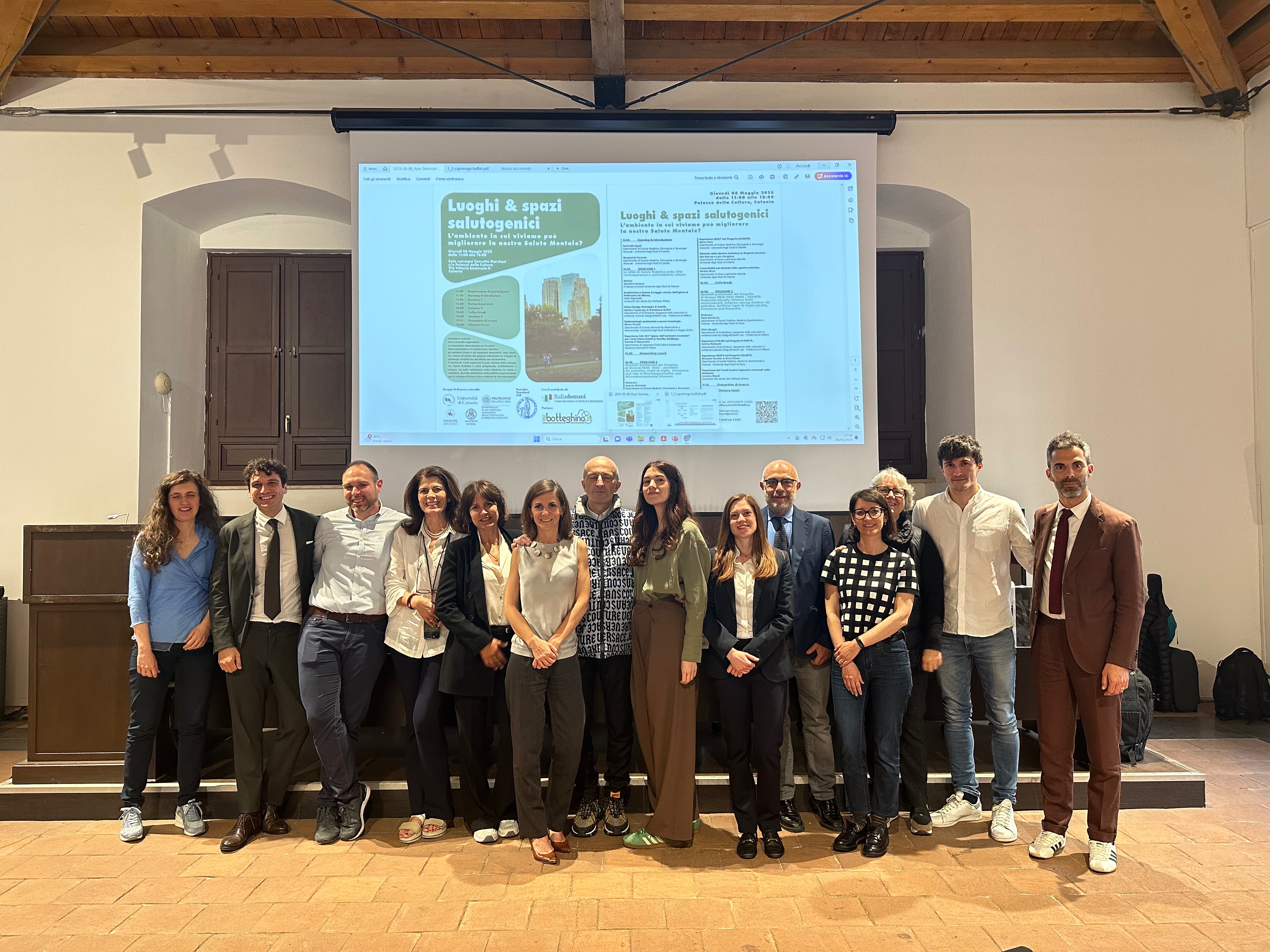
The results of the project will be presented today, 12 March 2026, during a seminar at the "Trifoglio" building of the Politecnico di Milano, from 4.45 pm to 5.30 pm.
CLICK HERE TO VIEW THE PHOTO GALLERY
Attachments
-
foto_di_gruppo_3.jpg
jpg 3 MB
Information at
Media Relations Office
relazionimedia@polimi.it
https://www.polimi.it
To receive Politecnico di Milano’s press releases, click here